How to Reduce No-Shows at Your Salon With Booking Deposits
No-shows cost salons, barbers and studios real money. Learn how booking deposits work, how much to charge, and how to set them up with Converbold.
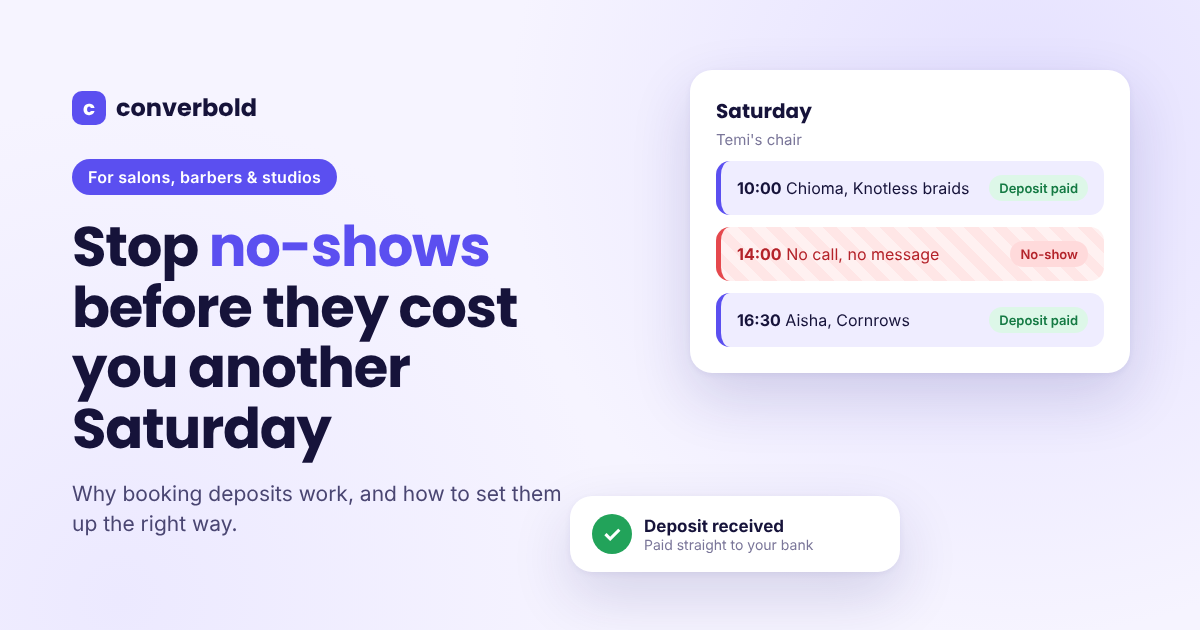
Every service business owner knows the feeling. You block out four hours on a Saturday for a client who promised she was coming. You turn down two other people who wanted the same slot. You set up your station, prepare your products and wait. Ten o'clock passes. Then half past. You send a message and it delivers but never gets read. By noon you accept it: she is not coming, and that time is gone forever.
That is a no-show. If you run a salon, barbershop, braiding studio, spa, clinic or any business that sells time, it is one of the most expensive problems you have. The good news is that it is also one of the easiest to fix. This guide explains why no-shows happen, why booking deposits work so well against them, how to set a deposit policy your customers will respect, and how Converbold makes the whole thing run without you having to chase anyone.
Why No-Shows Hurt More Than You Think
A product business can sell the same item tomorrow if nobody buys it today. A service business cannot. When a slot goes empty, that hour is lost permanently. You cannot sell last Saturday's 2pm appointment next week.
The cost is not just the price of the missed service. It includes:
- The customer you turned away. Someone else wanted that slot and you told them it was taken.
- Your staff's time. If you pay a stylist or barber to be in the chair, you pay them whether the client shows up or not.
- Preparation costs. Hair extensions bought for a braiding appointment, products mixed for a colour service, a room set up for a massage.
- Your energy. Planning a day around someone who does not respect your time is draining, and it makes you hesitant to trust the next booking.
For a small business, a few no-shows a week can be the difference between a good month and a struggling one. That is why serious owners stop treating no-shows as bad luck and start treating them as a problem with a solution.
Why People Don't Show Up
Most people who miss appointments are not bad people. Understanding why it happens helps you fix it.
Booking cost them nothing. When someone books by sending "I'll come Saturday" in your DMs, they have not committed anything. Cancelling costs them nothing, so not showing up costs them nothing either, and plans change easily when nothing is at stake.
They forgot. A booking made two weeks ago in a busy WhatsApp chat is easy to lose track of, especially when there was no confirmation and no reminder.
They found another option. Some customers send the same message to three salons and go with whoever answers first. You might be holding a slot for someone who already booked elsewhere.
Cancelling felt awkward. Many people would rather disappear than send an uncomfortable "sorry, I can't make it" message. Without an easy way to cancel, they simply do not turn up.
Look closely and three of these four reasons come down to one thing: there was no real commitment at the time of booking. A deposit fixes that.
How Booking Deposits Change Customer Behaviour
A booking deposit is a small payment the customer makes to secure their appointment. It goes toward the total price, so the customer is not paying extra. They are simply paying part of the price earlier.
It works because of a very human principle: people value what they have paid for. Once a customer has money in an appointment, it stops being a casual plan and becomes a commitment. They put it in their diary. They plan their day around it. If something genuinely comes up, they contact you because they want their money handled properly.
A deposit also filters out people who were never serious. The customer who sent the same message to three salons will usually only pay a deposit to one of them. If that is you, you know they are coming.
Many owners worry that asking for a deposit will scare customers away. In practice, the customers who leave over a reasonable deposit are often the same customers most likely to waste your time. Loyal customers understand. Most of them have experienced deposits at other good businesses and see it as a sign of professionalism.
How Much Should Your Deposit Be?
There is no single correct number, but there are sensible approaches. With Converbold you can choose any of these per service:
No deposit. Customers book for free and pay at the appointment. This works for quick, low-priced services like a simple haircut or a short consultation, where the loss from a no-show is small.
A percentage of the price. For example, 30% of the service price to secure the slot. This is a popular choice because it scales naturally. A small service gets a small deposit and a big service gets a bigger one.
A fixed amount. The same deposit regardless of the service. This is simple to explain and easy for customers to understand.
Full payment upfront. The customer pays everything when they book. This suits long, expensive or preparation-heavy services such as large braiding styles, bridal makeup or photoshoots, where a no-show would cost you a full day.
A practical way to decide is to ask: if this customer does not show up, how much do I lose? The bigger the loss, the stronger the case for a larger deposit. A four-hour knotless braids appointment with extensions deserves more protection than a fifteen-minute beard trim.
Writing a Cancellation Policy Customers Will Respect
A deposit works best with a clear cancellation policy. Customers need to know exactly what happens if their plans change. A fair policy usually answers three questions:
- How late can a customer cancel for free? For example, up to 24 hours before the appointment.
- What happens to the deposit after that point? You can keep it, refund it, or keep it as credit toward a future booking.
- What happens if they simply do not show up? Usually the deposit is kept, because the slot could not be resold.
The key is that customers should see the policy before they pay. Nobody likes surprises after the fact. With Converbold, customers see your policy before they book, so there is no argument later about what was agreed.
Keeping the deposit as credit is a friendly middle ground worth considering. The customer does not feel punished, you keep the money in your business, and they have a reason to come back and book again.
Why Collecting Deposits Manually Doesn't Scale
Plenty of businesses already ask for deposits through bank transfers in WhatsApp. It is better than nothing, but it creates its own problems.
You send your account number, then wait. The customer says they have paid. You have to check your bank app to confirm the money came in. Sometimes it has not. Sometimes they send a screenshot and you cannot tell if it is real. Meanwhile someone else asks for the same slot and you are not sure whether to hold it or give it away.
Multiply that by every booking in a week and you have spent hours being a part-time accountant instead of doing the work customers pay you for.
How Converbold Handles Deposits for You
Converbold is an online booking platform built for salons, barbers, spas, clinics, studios and every business that runs on appointments. Deposits are one of its core features, and they work without you having to touch a single transaction.
Here is how it works:
You set the deposit once. For each service you add in Converbold, choose no deposit, a percentage, a fixed amount or full price. That rule then applies automatically to every booking.
You connect your own payment provider. Converbold works with Paystack, Flutterwave and Stripe, so whether you are in Lagos, Accra, Nairobi, London or Toronto, you can use a provider that works in your country. Customers pay by card, bank transfer or USSD, depending on what your provider supports.
The money goes straight to your bank. This is important. Converbold never holds your money and never sees card details. Deposits go from your customer through your own payment provider and settle into your account on that provider's normal schedule. Converbold does not take a cut of your deposits either. Only your provider's normal processing fee applies.
Every payment is verified before the booking is confirmed. Converbold checks each payment with the provider, so you never have to wonder whether a screenshot is genuine.
The slot is held while they pay. When a customer picks a time, Converbold holds it for 30 minutes while they complete payment. If they do not pay, the slot is released for someone else. No more holding appointments for people who never follow through.
Manual payments still fit in. If a customer paid by direct bank transfer, you can mark the deposit as paid in one tap. For bookings you take over the phone, you can send a payment link on WhatsApp so the customer pays the deposit the same way.
Tracking No-Shows So You Can Improve
Fixing no-shows is easier when you can see them. In the Converbold calendar, you mark each appointment as completed or no-show. Over time, that builds a clear picture of your business.
Each customer's record shows how many visits they have made, what they have spent and how many times they did not show up. If someone has missed three appointments, you will know before you accept their next booking. Converbold reports also show your no-show rate for any period compared with the one before, so you can see whether your deposit policy is working.
This turns a frustrating problem into something you can measure and manage.
Reminders Close the Gap
Deposits deal with commitment. Reminders deal with forgetfulness. Together they cover the most common reasons people miss appointments.
Converbold sends email reminders on every plan. On paid plans you can also send WhatsApp and SMS reminders, which use credits that you buy when you need them and that never expire. A quick reminder the day before an appointment gives the customer a chance to reschedule if something has changed, rather than quietly not showing up.
Getting Started With Deposits on Converbold
Setting up takes about ten minutes:
- Create your free account at converbold.com. No card is needed to start.
- Add your services, with prices, how long each one takes and the deposit you want for each.
- Set your opening hours, breaks and any days you are closed.
- Connect Paystack, Flutterwave or Stripe so deposits go to your bank.
- Write your cancellation rules so customers know what to expect.
- Share your booking link in your Instagram bio, WhatsApp status and Google profile.
From then on, customers choose a service, pick a real available time and pay the deposit, and the booking lands on your calendar. You find out about it when it is already confirmed and paid for.
Converbold has a Free plan for one person and up to 50 bookings a month, and paid Starter and Pro plans for growing teams, priced for your region and billed in your local currency. You can compare everything on the Converbold pricing page.
No-shows are not something you have to accept as part of running a service business. With a fair deposit, a clear cancellation policy and a booking system that handles the money for you, the people who book with you will show up. Create your free Converbold booking link today and protect your next Saturday.
Written by
Converbold
We build Converbold for businesses that run on appointments. Questions or ideas for a guide? Tell us.